
About
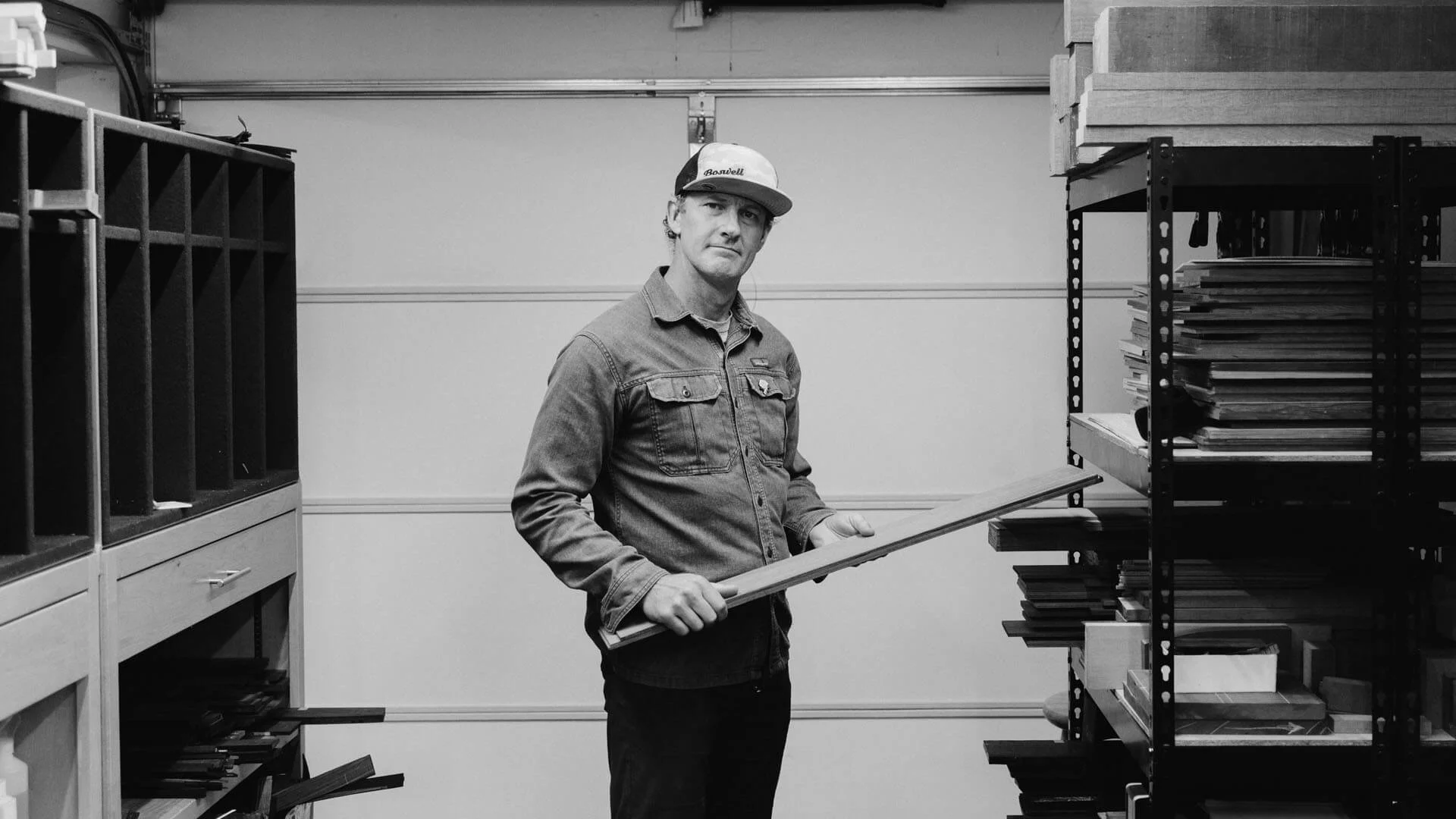
I can trace my love for guitars back to when I was in grade school and just learning to play. Looking back, I can recall being just as content sitting staring at the guitar as playing it. I was enamored. My engineering mind would take over, wondering what purpose each part - and the sum of its parts - served. Picking up a guitar would quickly go from concentration on playing songs, to a need (albeit subconsciously at the time) for a deeper understanding of what was happening inside.
Through high school and college I played guitar constantly, for a time even bordering on making a professional go of it. Still, I found myself drawn as much to what was going on inside the guitar as to what was coming out of it. I graduated in the Architectural Engineering department at CalPoly in 1998, so looking back, it makes sense that the artistry, design, and functionality of instruments had become just as important to me as playing them. Over the next decade, I worked in repair shops (Blue Note Music 1994-2006, Rudy’s Music, NYC 2001-2003), factory environments (Taylor Guitars 1999), and in 2007 opened my own retail/repair shop (Butch’s Guitar & Repair), which ran successfully until 2015. I loved handling stringed instruments, but more so figuring out what made each one of them “go”. What made them unique from one another? For many years, it seemed that guitar repair was my true calling, but it was more than just guitars. I was immersed in all stringed instruments. Guitars, banjos, mandolins, ukes, resonators, violins, violas, cellos, and yes, even the occasional auto-harp. You name it, I handled it, fixed it, studied it, learned from it.
In 2010, while supporting a family of four and already running a very busy repair shop, I decided to build my first acoustic guitar. Deciding to do so did not come lightly. Tools, materials, and time were all very valuable commodities, most of which at this point in my life, I either didn’t have, or couldn’t afford. With the help of a very supportive family, I managed to make it happen, and what I realized was this: The deep curiosity I had always felt regarding an instruments’ internal workings, the admiration surrounding the artistry and design, and nearly two decades of repair experience had all led me to this moment. Making this “prototype” as I called it, got the hooks in deep, and I knew this first guitar was just the beginning. I was now determined to make it work.
The path to becoming a guitar maker would prove to be one of the more difficult things I would ever do in my life. In most cases, when it came to solving the luthiery problems that I faced, I relied solely on myself. I didn’t like asking for help. Whether out of pride, or fear of looking foolish, the effect was the same. Most of the time I was figuring things out “the hard way” and it took its toll. For years I had to repair instruments full-time in order to afford my fledgling, or perhaps flailing luthier life. Fortunately, the volume of repair work wasn’t slowing down. As a matter of fact, I had more than I could keep up with. A few guitar orders were trickling in, but I was also faced with supporting a growing family and the time and financial obligations that came along with it all. Needless to say, I was hustling. All day, every day. It was a sort of “robbing Peter to pay Paul” time, and one I don’t look back on fondly. This period in my life was quite easily one of the hardest and scariest times I would ever experience. It was also the time where I was laying the groundwork for my vision of what would eventually become Boswell Guitars.
In August of 2015, my family and I relocated to Bend, OR. It was here in Bend where my career as a luthier finally started to flourish. After continuing to juggle the guitar repair/guitar maker life for several more years in the new shop, something finally changed. By this point, I knew that the instruments I was making were damn good. I had accrued the materials, and had the experience necessary to make truly great guitars. I knew all I needed now was to get them into the right hands. Web work, social media, advertising- none of it carries the weight of good, well-established representation, and in 2018 I reconnected with my friend and former boss Rudy Pensa of Rudy’s Music fame. We did a couple small projects together, the first of which were two 1937 Advanced Jumbo copies. These two builds were based off of an actual 1937 Gibson AJ that I had restored and sold to Rudy just a few months prior. The second was a small run of 11 all-mahogany pre-war Martin 0-17 copies. These two projects completely changed the trajectory of my career. It was the two AJ’s that really kicked things off between myself, Rudy and his staff. After getting his hands on the AJ’s, Rudy suddenly became very interested in other models I could make. He wanted to see what I could do. After he received a few more, I was told to just send whatever I made and he’d buy it. This was a really fun time of building for me. My creativity was allowed to kick in more fully, and I was experimenting with shapes, materials, colors, bracing, and design ideas that I hadn’t been able to in the years past. One model in particular used a Tunnel 13 redwood top, a double X brace top pattern (something that I pridefully feel I helped to re-introduce to the luthier world), a custom burst finish on the redwood top, and a perpendicular back bracing bar for added reflective stability. I was finally in my element. It was the second project though, the little 0-17 copies (my 0-14M/3S) that changed everything.
It wasn’t long after I got Rudy several of the 0-14M/3S guitars that he revealed to me that his long-time friend, Mark Knopfler, was getting one. I was stunned to say the least. I thought I was dreaming. Mark went on to use that guitar almost exclusively on his newest record, ‘One Deep River’. At his request, I made Mark a second guitar, an OM out of Koa with a Tunnel 13 redwood top, just like the one mentioned prior. He took great interest in the story of the Tunnel 13 robbery, and ended up turning it into a song on the new album duly titled “Tunnel 13”, and to my astonishment, the last line of the song being: “Tunnel 13 is the place in the song, where the beautiful redwood for my guitar came from.” The relationship between Mark and Rudy and myself has been magical. I’ve been so fortunate to now have made 4 guitars for Mark, we have collaborated on two incredible “MK” projects, and through Mark, managed to donate one of the MK guitars to a charity auction, generating a rather large sum of money for Nordoff and Robbins, the UK’s largest music therapy charity.
Today, I am in a very fortunate position. I’m making the guitars that I want to make, for the people I want to make them for. I have often found myself saying “Now here is a great little guitar for an even greater person!” It’s the truth too. I’m so lucky to be able to make the right guitar for someone that I have had the opportunity to get to know, ask questions, and develop a relationship with that goes beyond just buyer and maker. In 2023, after 25 years, I was finally able to make the announcement that I was no longer accepting repair work. At long last, I had made the transition to full-time luthier.